
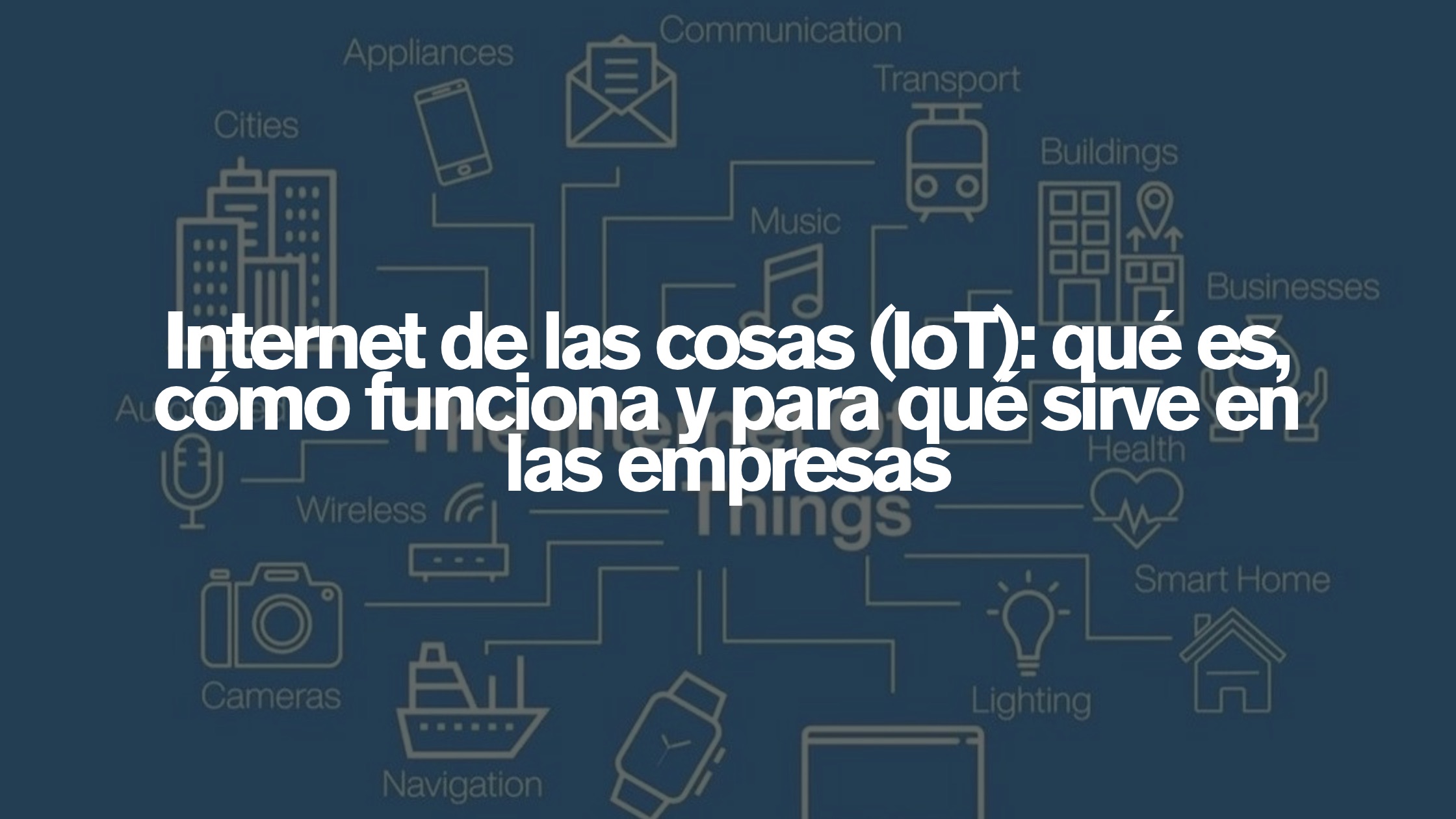
The Internet of Things (IoT) is a technology that connects physical objects to networks to collect, transmit and exchange information. It uses sensors, software and connected devices to monitor conditions, generate data and, in some cases, carry out actions automatically.
What if objects could communicate and share information?
Think of a watch that tracks your steps, a light you can turn on by clapping, a vacuum cleaner you control from your phone, or a car that tells you when it needs maintenance. Although they seem like very different devices, they have something in common: they can collect information and share it over a digital connection.
Now let's take that idea to a company. Imagine a factory that needs to supervise the temperature of its equipment, a warehouse that needs to know the condition of its products, or a building that wants to control its lighting and energy consumption. Instead of relying only on on-site checks, these organizations can use connected devices to get information about what's happening in their facilities.
We know this technology as the Internet of Things, or IoT: a network of physical objects that incorporate sensors, software and connectivity to collect and share information, and that is gradually changing the way we do different activities by interacting with the objects around us.
According to IBM, IoT devices can range from smart household objects to industrial machinery and transport systems; their main characteristic is that they can exchange data with other devices and connected platforms. In other words, objects don't just perform a physical function; they also provide information about their state or what's going on around them.
A conventional thermostat lets you adjust the temperature manually, while a smart thermostat can measure the room's temperature, send information to an app and adjust its operation according to certain conditions. The difference lies in the ability to collect information, communicate it and use it to make decisions or carry out actions.
How does the Internet of Things work?
Although it can seem like a complex technology, an IoT system can be understood through four stages: collecting information, transmitting it, processing it and generating a response. Let's look at each one.
1. Sensors collect information
Everything starts with a device that detects something in its surroundings. Sensors can measure different variables, such as:
- Temperature.
- Humidity.
- Movement.
- Pressure.
- Location.
- Liquid level.
- Electricity consumption.
For example, a temperature sensor installed in an industrial refrigerator can constantly record storage conditions.
2. Devices transmit the data
Once the information is collected, the device needs to send it to another system so it can be used. This can be done through different connectivity technologies, such as Wi-Fi, Bluetooth, cellular networks, Zigbee or LoRaWAN. The choice depends on factors such as distance, power consumption, the amount of information to transmit and the conditions of the place where the devices will be installed.
3. The information is processed
The collected data reaches a platform that organizes and analyzes it; there it can be compared against set parameters to identify changes, unusual behavior or situations that need attention. For example, if a cold room must stay within a certain temperature range, the system can compare the readings with that limit.
4. The system generates a response
Finally, the processed information can be used to show results, send alerts or trigger certain actions. For example:
- Sending an alert when the temperature exceeds the set limit.
- Notifying when a piece of equipment shows an unusual condition.
- Turning on a ventilation system.
- Automatically recording the consumption of a resource.
- Showing up-to-date information in an app.
This means IoT isn't limited to connecting devices: it lets you use the data they generate to better understand what's happening and act when necessary.
What is industrial IoT and how does it differ from traditional IoT?
When researching the Internet of Things you may come across another term: IIoT, which stands for Industrial Internet of Things. Both concepts are related, but they don't have exactly the same focus.
IoT covers the connected devices we find in different environments, such as homes, cities, vehicles and businesses, while IIoT focuses specifically on industrial applications, where connected devices are used to supervise machinery, control production processes and get information about operations. For example:
- A smartwatch that tracks physical activity is an IoT device.
- A sensor that monitors the vibration of an industrial machine is part of an IIoT application.
In industry, these technologies usually work alongside automation systems, industrial control and analytics platforms to improve process supervision.
Benefits of the Internet of Things for your business
Implementing IoT can bring several benefits, as long as devices and systems are selected according to the organization's needs. Among the main ones are:
01 · Real-time monitoring
Check equipment, facilities and processes without relying only on on-site inspections.
02 · Anomaly detection
Get alerts when a variable exceeds its limits or behaves unusually.
03 · Better use of resources
Consumption and operation data help spot opportunities for improvement.
04 · Informed maintenance
Detect changes in how equipment performs and plan interventions in time.
05 · Data-driven decisions
More recorded information to understand what's happening in your operation.
06 · Remote supervision
Check information from digital platforms, even when you're not on site.
This is exactly what we do with Horus, our real-time monitoring solution for diesel, water and energy.
So, what do we take away?
The Internet of Things is changing the way people and businesses interact with physical objects. From a smartwatch to the sensors in an industrial plant, this technology makes it possible to collect information, supervise conditions and generate responses from data; for businesses, its value lies in gaining greater visibility into their operations and having information that helps them make decisions.
However, implementing IoT doesn't mean connecting devices without a purpose: first you need to identify what you want to know, which problem you want to solve and how the data will be used.
Technology has the most value when it responds to real needs.
At SERBIT we believe the Internet of Things is an example of how connecting the physical world with information can open up new possibilities for organizations.
Frequently asked questions
Does the Internet of Things (IoT) need the internet to work?
Not necessarily. Although many IoT devices use the internet to send information to cloud platforms and enable remote monitoring, they can also communicate over local networks. For example, some sensors send data to a hub device (gateway) that processes or forwards the information, so each sensor doesn't need to connect to the internet directly.
What is needed to implement IoT in a company?
You need devices or sensors that collect information, a communication network to transmit it and a platform to view and analyze the data. It's also important to define which problem you want to solve, ensure information security and check that the technology is compatible with the existing infrastructure.
What is the difference between IoT and artificial intelligence?
The Internet of Things (IoT) connects devices to collect and transmit information, while artificial intelligence (AI) uses algorithms to analyze data, identify patterns and generate predictions or recommendations. The two can complement each other: IoT devices collect information from the environment and AI helps interpret it to make better decisions.
Can the Internet of Things work without human intervention?
Yes. IoT devices can run actions automatically when they detect certain conditions, as long as they're configured to do so. For example, a sensor can trigger an alert when it detects a low water level or send a notification if it identifies unusual consumption, which makes it possible to automate tasks and reduce the need for constant supervision.
What happens to the data IoT devices collect, and who can access it?
The data collected by IoT devices can be stored on local platforms or in the cloud to be consulted, analyzed and turned into reports. Access depends on the system's configuration and the permissions assigned; that's why it's important to set access controls, protect communications and define who can view or manage the information.
Want your company's assets to warn you by themselves?
Meet Horus and see your diesel, water and energy on a single dashboard.